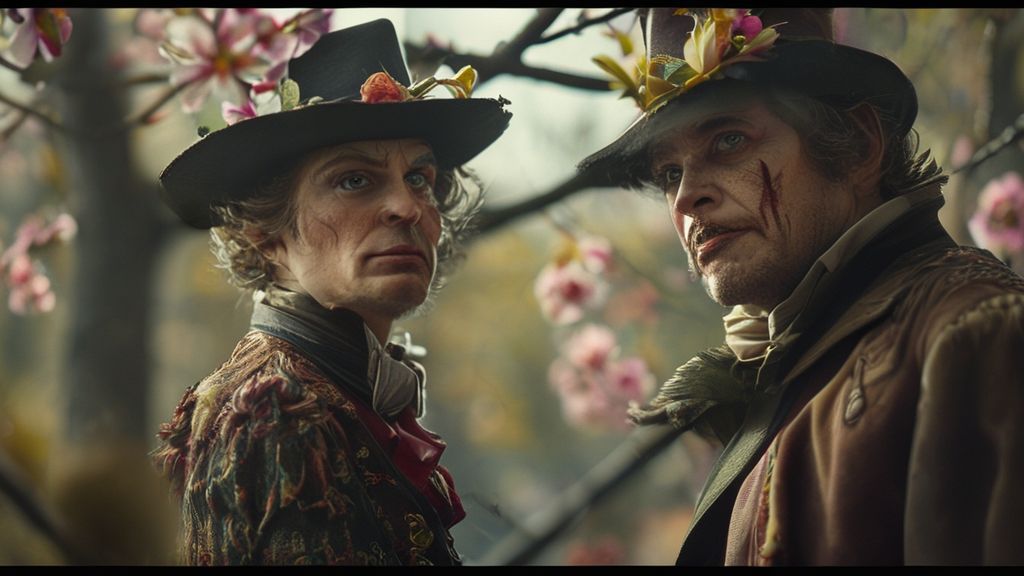
London, 1837. Queen Victoria had just ascended to the throne, and the Industrial Revolution shrouded the city in a mist of coal and gas. In this urban gothic setting, the first 'supervillain' of the modern era was born: Spring-heeled Jack. Unlike the ethereal ghosts of castles, Jack was a physical, urban, and brazen terror. He didn't lurk in cemeteries but in the dark alleys and public parks of the world's largest metropolis, defying the police and logic.
Early reports spoke of a spectral figure who leaped over three-meter walls with impossible ease, as if he had mechanical springs in his heels (hence his name). But the legend exploded in February 1838 with the attack on Jane Alsop. One night, a man knocked on her door, identifying himself as a police officer and asking for a light because 'they had caught Spring-heeled Jack in the alley.' When young Jane came out with a candle, she encountered a nightmare. The man removed his cape and revealed a diabolical appearance: he wore a tight-fitting suit of shiny white oilskin (like an old space or diving suit), had metallic claws on his hands, and his eyes were balls of red fire. Before she could scream, the creature vomited a jet of blue and white flame into her face and began to tear her clothes and skin with its claws.
Jane's screams alerted her family, and Jack fled, making prodigious leaps into the darkness. Days later, he attacked Lucy Scales in Limehouse, blinding her with his fiery breath. The panic was such that the Lord Mayor of London received anonymous letters denouncing the attacks and organized armed citizen patrols. The sensationalist press ('Penny Dreadfuls') fell in love with the character. What was Jack? The theories of the time were a fascinating mix of skepticism and superstition.
The rational theory pointed to an eccentric and sadistic aristocrat, Henry de La Poer Beresford, the Marquis of Waterford, known for his violent behavior, absurd bets, and contempt for women and the law. It was said that he had designed boots with springs and a mechanism to spit fire (possibly alcohol and phosphorus) to terrorize the common people as a perverse sport. However, Jack's attacks continued decades after the Marquis's death, appearing in Liverpool, in military barracks (where sentinels shot at him without harming him), and on the rooftops of the Midlands until 1904.
Jack evolved over time. He went from being an aggressor of women to an almost paranormal figure, a 'trickster' who slapped soldiers and laughed at the police from unreachable rooftops. He never killed anyone, but his presence generated an electric terror. For cultural historians, Spring-heeled Jack is the missing link between ancient demonic folklore and modern superhero comics (he is a clear inspiration for Batman and the Joker). He represents the fear of unknown technology and the anonymity of the great Victorian city, where a monster could be a demon from hell or simply a wealthy gentleman with too much free time and a strange suit.