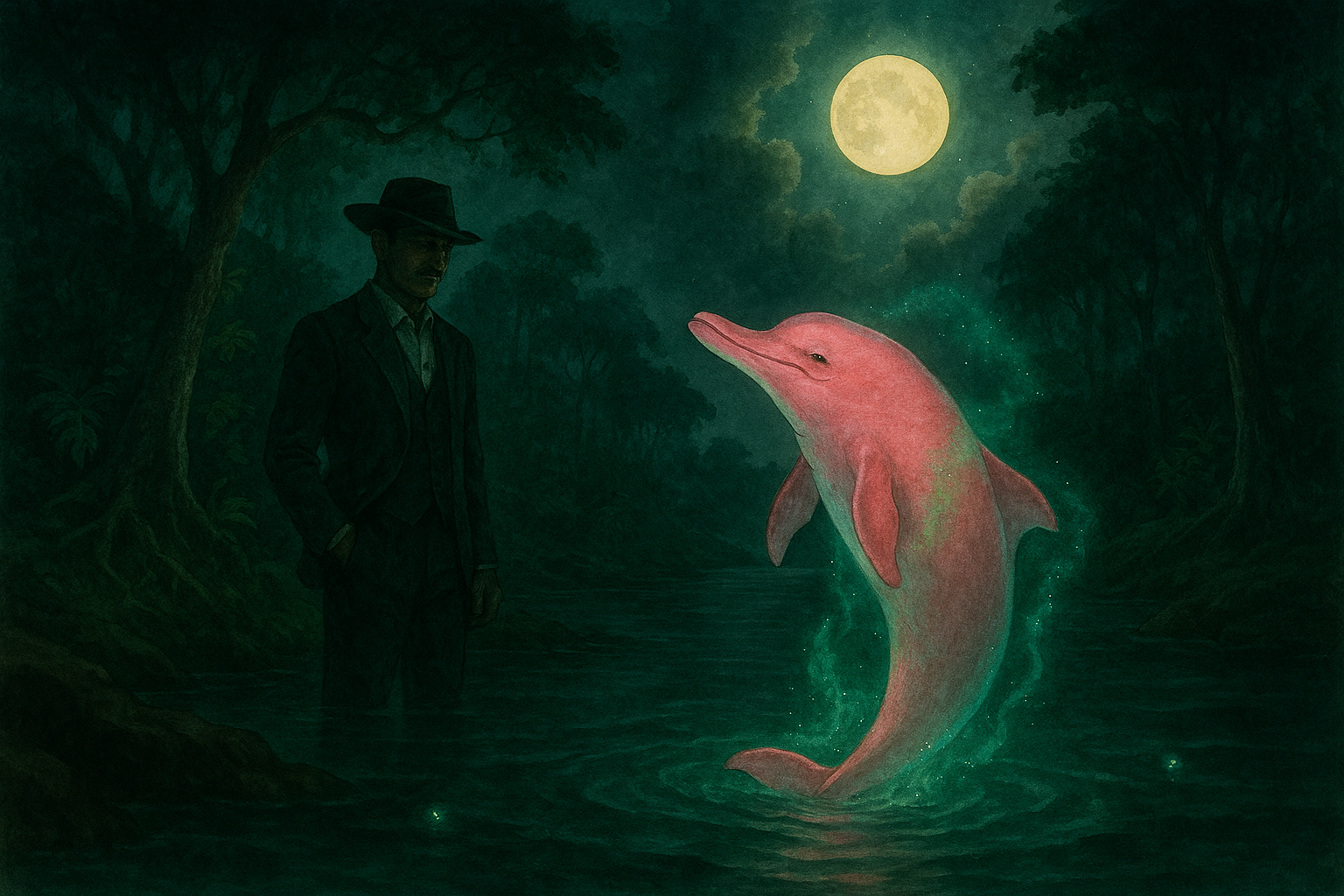
Along the banks of the Amazon, where the river serves as street, larder, and life's central mystery, there exists a legend that explains the unexplainable with seductive and dangerous poetry: the Enchanted Boto. The 'boto' is the Amazon pink dolphin, an intelligent and curious animal that interacts with fishermen. But in the caboclo (mixed-race) imagination, the boto is much more than an animal; it is a magical being, a shapeshifter, and the ultimate lover.
The legend recounts that during festive nights, especially during the celebrations of Saint John (Festas Juninas), when forró music fills the air and cachaça flows freely, the boto emerges from the water. It crawls to the riverbank and transforms into a human man. But not just any man. He becomes an irresistible charmer: tall, strong, with white skin (like the dolphin's pink belly) and magnetic elegance. He dresses impeccably in white, with gleaming shoes, and always, invariably, wears a hat.
The hat is the key. The Boto wears it to hide the only feature he cannot transform: his blowhole, the respiratory opening on the top of his head. If someone were to remove his hat, they would discover his animal nature. But the Boto is cunning and charming. He arrives at dances and chooses the most beautiful woman at the party, usually a young virgin or a solitary woman.
His seductive talents are supernatural. He dances like no other, whispers words more intoxicating than alcohol, and looks with eyes that promise a world of underwater pleasure. The chosen woman succumbs to his charm, forgetting everything: family, caution, and honor. The Boto convinces her to leave the dance and walk towards the riverbank. There, they make love passionately. Before the sun rises, the perfect lover bids farewell, runs towards the water, and plunges into the river, regaining his dolphin form and disappearing into the dark depths of the Amazon.
The consequence of this encounter is, invariably, a pregnancy. In traditional Amazonian culture, when a young girl became pregnant with no known father, or after a fleeting affair, people would say: 'It was the boto.' 'Filho de boto' (child of the boto) is a common expression in the region to refer to children of unknown paternity. Far from being merely a naive excuse to conceal indiscretions or abuses, the Boto myth functioned as a social integration mechanism. By attributing paternity to an enchanted being, some of the stigma was removed from both mother and child. The child was not just any bastard, but the offspring of a magical being.
However, the Boto also has a dark side. He is said to be jealous and vengeful. Sometimes he tries to take women to the bottom of the river, to his submerged city (the Encante), where the drowned and magical creatures live in palaces of gold and crystal. Those taken by the Boto lose their minds or drown, becoming beings of the deep. Therefore, women are warned not to approach the river alone at night, and men not to trust overly elegant strangers who appear at parties and never remove their hats.
The Enchanted Boto personifies the mystery and seduction of the Amazon River. The river gives life with its fish, but it can also steal or change it. It is an indomitable, attractive, and dangerous force, capable of taking human form to mingle with us and remind us that, in the jungle, magic is as real as the running water.