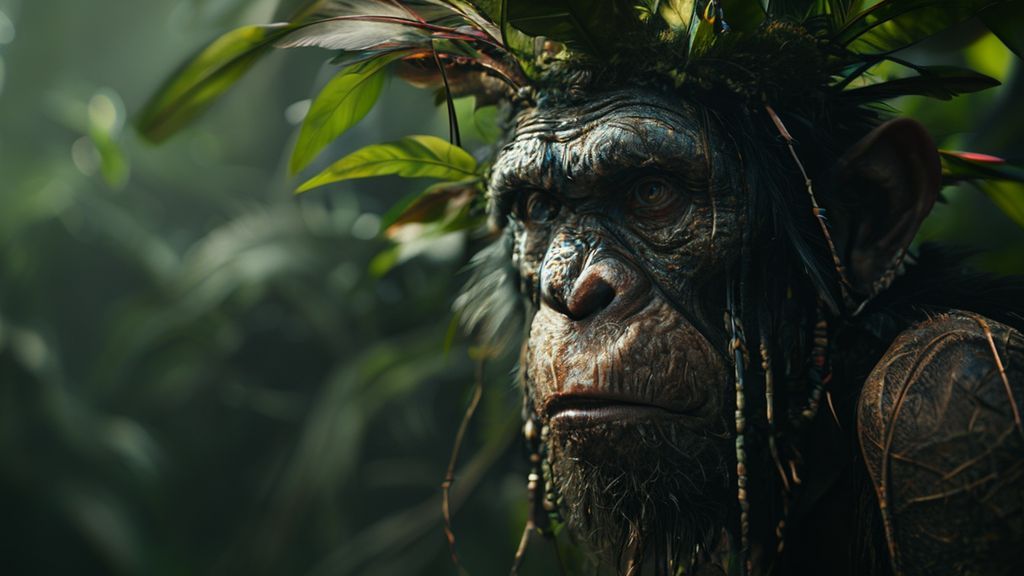
To venture into the Amazon rainforest is to enter a green temple, immense and dangerous, where human rules cease to hold value. There, the true sovereign is neither the jaguar nor the anaconda, but the Curupira. This being is one of the oldest and most powerful entities in Brazilian folklore, a myth born from the indigenous Tupí-Guaraní reverence for the forest, and one that has endured as a fierce symbol of environmental conservation.
The Curupira is described as a being of deceptive and strange appearance. He is short in stature, like a child or a robust dwarf, possessing immense physical strength. His skin can be green like leaves or dark like bark, and his hair is a fiery red, bright and dishevelled. But his most distinctive feature, that which makes him unmistakable and tactically invincible, are his feet: they are inverted, with heels facing forward and toes pointing backward.
This inverted anatomy is his master weapon. When the Curupira walks through the jungle, his footprints appear to indicate that he is moving away from a place, when in reality he is heading towards it. This irremediably confuses hunters and explorers who try to track or flee from him. They follow the tracks believing they are chasing prey or looking for an exit, and end up going deeper and deeper into the thicket, straight into the trap the Curupira has prepared for them.
The Curupira's purpose is clear and noble: he is the guardian of flora and fauna. He is not an enemy of man by nature, but an enemy of greed and destruction. He tolerates those who hunt out of necessity, to feed their families, respecting the cycles of life. But his wrath is unleashed against those who hunt for sport, who kill pregnant females or young, who fell trees without permission, or who waste forest resources. These human predators, the Curupira punishes without mercy.
His methods are both psychological and physical. He uses sounds, whistles, and voices that imitate game animals or even human companions to separate hunters, disorient them, and make them walk in eternal circles. The 'charm' of the Curupira causes vertigo, amnesia, and a panicking terror that drives people mad. Many hunters have been found days later, wandering aimlessly, babbling incoherently, or have never been found at all. Sometimes, the Curupira kidnaps hunters and beats them, or forces them to promise never to harm the jungle again.
Despite his ferocity, the Curupira has weaknesses. He is curious and enjoys tobacco and aguardiente (sugarcane brandy). Locals know that, to enter the forest safely, they must ask permission and leave an offering of tobacco or 'fumo de rolo' (roll tobacco) at the jungle entrance. It is also said that he is fascinated by knots; if one feels pursued by him, they can leave a liana with a complex knot in their path. The Curupira, being obsessive, will stop to untie the knot, giving the victim time to escape.
The Curupira is the personification of the self-defending jungle. In a world where the Amazon suffers constant devastation, his legend takes on a painful and necessary relevance. He is not a monster from the past; he is nature's cry of warning, reminding us that the forest is alive, that it watches us, and that if we cross the boundaries of respect, it has the power to make us disappear without a trace.