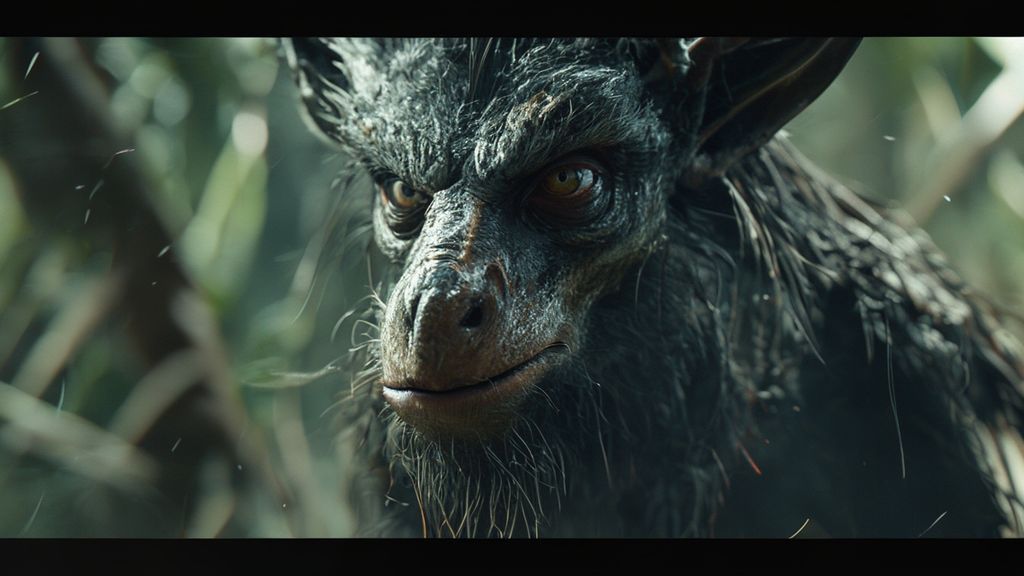
If Dracula defined the 19th century, the Chupacabra is the definitive monster of the era of globalization and mass media. Emerging in Puerto Rico in 1995, its legend spread like a computer virus throughout Latin America and the southern United States, becoming the first cryptid of the Internet age. Unlike ancient legends that took centuries to form, the Chupacabra was born, mutated, and consolidated in a matter of months, fueled by television sensationalism and fin-de-siècle social paranoia.
It all began in the municipality of Canóvanas, Puerto Rico. Farmers started finding their animals (goats, sheep, chickens, and even dogs) dead in an inexplicable manner. They hadn't been devoured or torn apart by wild dogs. The bodies were intact but completely drained of blood. They presented very specific, surgical-like marks: two or three perfectly circular holes in the neck or chest, penetrating vital organs, with no trace of spilled blood on the ground. It was as if they had been suctioned with an industrial hypodermic needle.
The first key witness, Madelyne Tolentino, described the creature, and her testimony created the iconic image of the 'Alien Chupacabra': a bipedal being approximately five feet tall, with greenish-gray scaly skin, large, almond-shaped red eyes (similar to those of ufology's greys), and a row of colorful spines or quills running down its back from head to tail. It was said to move by kangaroo-like leaps and could fly or glide short distances. It had sharp claws and an unbearable sulfurous odor.
The hysteria was absolute. Citizen posses were organized, the mayor of Canóvanas led official hunts, and the story jumped to 'Primer Impacto' and CNN. The predominant theory on the island was that it was a genetic experiment escaped from U.S. laboratories in El Yunque National Forest, or an alien pet abandoned by a UFO. The Chupacabra embodied post-colonial distrust towards the U.S. government and military secrets.
However, when the legend jumped to Mexico and the southwestern U.S. (Texas), the monster mutated. It ceased to be a bipedal alien and became the 'Canid Chupacabra': a quadrupedal beast, similar to a dog or coyote, but hairless, with bluish or grayish skin, prominent fangs, and longer-than-normal hind legs. This version is the one most often 'captured' or found dead on roads. Science has explained these cases as coyotes or dogs with severe sarcoptic mange, a disease that causes hair loss, thickens the skin, and weakens the animal, forcing it to attack easy prey (like chickens) instead of wild game.
But the veterinary explanation isn't enough to kill the myth. The Chupacabra touched a raw nerve: the fear of invisible predation. It attacked the most valuable asset of the poor farmer: their livelihood (livestock). Furthermore, its modus operandi (vampirism) connected it with ancestral fears, but updated with a science fiction aesthetic. In Mexico, during the economic crisis of the 90s, the Chupacabra even became a political symbol, a smokescreen ('the Chupacabra is the government sucking our blood').
Today, the Chupacabra has entered pop culture, appearing in cartoons and movies, losing some of its initial terror. But in rural areas, when ten sheep are found dead at dawn with two holes in their necks and not a drop of blood, farmers don't think about mangy coyotes or politics; they load their shotguns and watch the barn roof, hoping to catch a glimpse of those red eyes glowing in the dark.